Sporting clays is one of the most fun shotgun disciplines because it has so much variety, but that’s also what makes it intimidating for beginners. Different stations, different target presentations, and different pairs can make it feel like there’s too much to learn at once. These 5 beginner techniques will simplify the game fast and help you start breaking more pairs with confidence.
In this article
- WHAT IS SPORTING CLAYS?
- TECHNIQUE #1: USE YOUR EYES CORRECTLY
- Sporting clays is a hand-eye coordination sport. And if your eyes aren’t working right, your hands won’t either.
- TECHNIQUE #2: NAIL YOUR SETUP BEFORE YOU CALL PULL
- Sporting clays rewards preparation. High-level shooters make it look easy because so much of the shot is decided before they ever call pull.
- TECHNIQUE #3: CHOOSE SMART BREAK PONTS
- Not all break points are created equal. One of the fastest ways to improve is simply choosing break points that make your life easier.
- TECHNIQUE #4: UNDERSTANDING LEAD WITHOUT MEASURING
- Lead is the forward allowance—how far ahead of the target you need to shoot so the shot pattern and the target arrive at the same place at the same time.
- TECHNIQUE #5: KNOW YOUR APPROACHES TO TARGETS
- Once you understand vision, setup, break points, and lead, you still need a repeatable way to actually approach targets.
- FINAL THOUGHTS
WHAT IS SPORTING CLAYS?
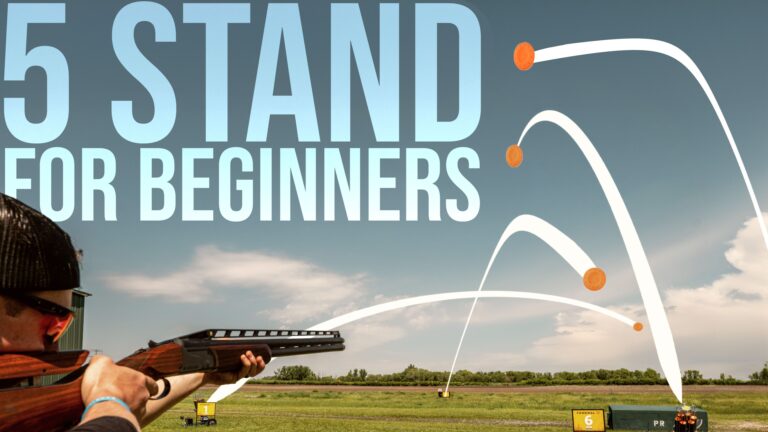
Sporting clays is a shotgun sport often described as “golf with a shotgun.” Instead of standing on one field, you move through a course made up of different stations, and each station presents clay targets in unique ways to simulate real hunting scenarios. At each station, you typically shoot pairs of targets—either both at once (true pair) or one followed by the other after your first shot (report pair). The goal is simple: read the target flight, make a plan, and break as many clays as possible as you work your way through the course.
TECHNIQUE #1: USE YOUR EYES CORRECTLY
Sporting clays is a hand-eye coordination sport. And if your eyes aren’t working right, your hands won’t either.
Two key parts of using your eyes correctly:
- Eye dominance: A lot of youth shooters assume if they’re right-handed, they must be right-eye dominant. That’s often not true. Cross-dominant shooters (right-handed, left-eye dominant) are extremely common. If you’re just getting started, learning to shoot on your dominant eye side is one of the biggest shortcuts you can take to long-term success—because you don’t want to fight your eyes. Sporting clays makes this even more important than trap, because the target presentations vary so much more. If your vision isn’t dialed, sporting clays will expose it quickly.
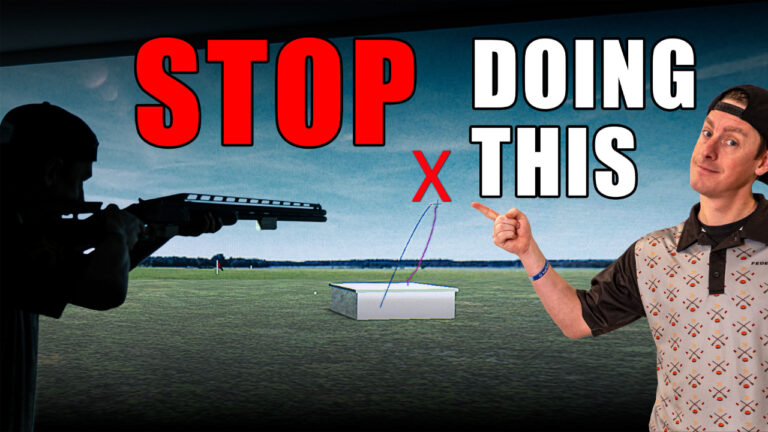
- Focus: Where your focus goes, your shotgun flows. If you focus on the wrong thing, your hands will move to the wrong place. One of the biggest mistakes I see is shooters trying to focus on the bead, or trying to “look at the lead.” The moment you start measuring lead, you’re pulling your eyes off the clay. In the video, I demonstrate this on the TrueClays simulator. When I focus on the bead instead of the target, I’m late, I’m behind, and my brain never fully catches up to the line and speed of the bird.
The goal: stay Target Focused. When the target appears, lock your vision onto it—especially the leading edge—so your movement stays connected to what the target is actually doing.
TECHNIQUE #2: NAIL YOUR SETUP BEFORE YOU CALL PULL
Sporting clays rewards preparation. High-level shooters make it look easy because so much of the shot is decided before they ever call pull.
Your setup has three key pieces:
- Break point: where you intend to break the target
- Hold point: where you start the muzzle (usually below the line of flight so you can see the bird clearly)
- Focal point: where your eyes start, so you can pick up the target early and clearly
In the video, we walk through setting up a report pair on TrueClays and show how much difference it makes when your gun starts in the right place, your eyes are in the right place, and your body is positioned for your planned break point. Then we show what happens when you’re not intentional—gun too low or too high, eyes in the wrong place, feet not set, and suddenly you’re rushing, whipping, and guessing.
Sporting clays doesn’t have to be hard—but you can make it hard real quick if your setup is sloppy.
TECHNIQUE #3: CHOOSE SMART BREAK PONTS
Not all break points are created equal. One of the fastest ways to improve is simply choosing break points that make your life easier.
In the video, we use a show pair example where a target comes across, slows down, and drops off. You can shoot it early while it’s under power and predictable, or you can wait until it comes out of transition and becomes predictable again. The “right” choice depends on you—your comfort, your strengths, and what the second bird is doing.
Here’s the big point: your break point decision affects everything, especially your transition to the second target. If you wait too long on bird one, bird two might come out and you’re instantly playing catch-up from behind. If you choose a smart break point, you can minimize movement and make the pair feel simple.
TECHNIQUE #4: UNDERSTANDING LEAD WITHOUT MEASURING
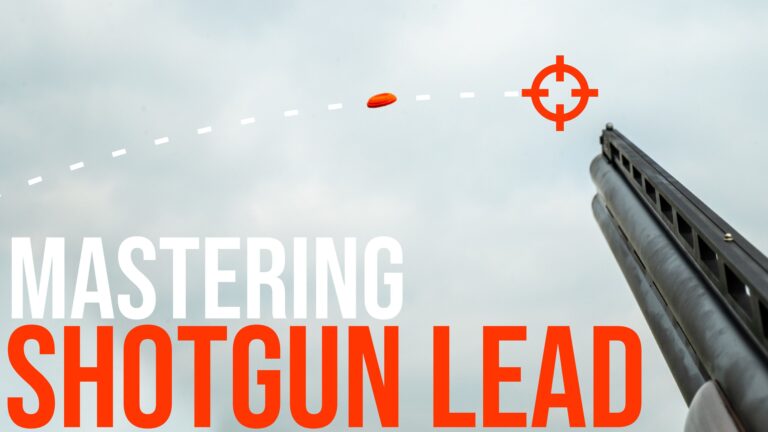
Lead is the forward allowance—how far ahead of the target you need to shoot so the shot pattern and the target arrive at the same place at the same time.
Lead is primarily driven by three things:
- Target speed
- Target distance
- Target angle relative to you
But here’s the trap: trying to measure lead often ruins lead. When shooters try to be precise with lead, they start checking the bead, looking for a gap, or “calculating” mid-swing—and that steals focus from the target.
A simple way to think about lead is in buckets. Little lead, Decent lead, A lot of lead.
Gil Ash once said: Be precise in your focus and sloppy on your lead. The idea is that your visual precision matters most. You’re shooting a pattern, not a rifle bullet. If you stay locked onto the target and move correctly, the lead tends to take care of itself over time through repetition.
TrueClays is helpful here because it shows the required lead on the replay, which helps you learn what “a little” or “a lot” actually looks like for different presentations.
TECHNIQUE #5: KNOW YOUR APPROACHES TO TARGETS
Once you understand vision, setup, break points, and lead, you still need a repeatable way to actually approach targets.
Let’s break down three common approaches:
- Swing-through: let the target beat you, insert behind, accelerate through, fire as you pass the correct lead
- Pull-ahead: match the target, then pull ahead into the lead right before the shot
- Sustained lead: stay out in front of the target the whole time and maintain the lead window
Each approach can work. Each with their own tradeoffs. For example, swing-through can feel very natural (especially for hunters), but timing becomes critical because the gun is moving faster than the target at the shot. Sustained lead can look incredibly smooth, but it can be harder when a target requires a large lead window. The goal isn’t to make you pick one forever. The goal is to understand what these approaches are, what they feel like, and why they work—so you can build tools in your toolbox as you grow.
FINAL THOUGHTS
What I love about sporting clays is the variety—and what I love about teaching it is watching people go from overwhelmed to confident once they have a simple plan. This video is built to simplify the game for beginners and youth shooters by focusing on five fundamentals that matter: vision, setup, smart break points, lead without measuring, and having a clear approach to targets.
My favorite part of filming this was using the TrueClays simulator to show these concepts visually. It’s one thing to explain “don’t look at the bead” or “pick a break point,” but it’s another thing to see the replay and understand why you were late, why you rushed, or why your transition broke down.
If I’m being honest, the only downside is that sporting clays is so deep that five techniques barely scratch the surface. You could do a full video on any one of these topics. But that’s also the point: this is a beginner foundation, not an advanced masterclass. If you start here, you’ll be ahead of most people walking onto a course for the first time—and you’ll have a framework to keep improving every time you shoot.
And remember, whether it’s targets in the field or targets in life, you’ll only hit what you’re focused on — live the #TargetFocusedLife.