Best Elite Sporting Clays Shotguns | We Only Kept One
Aug 06, 2026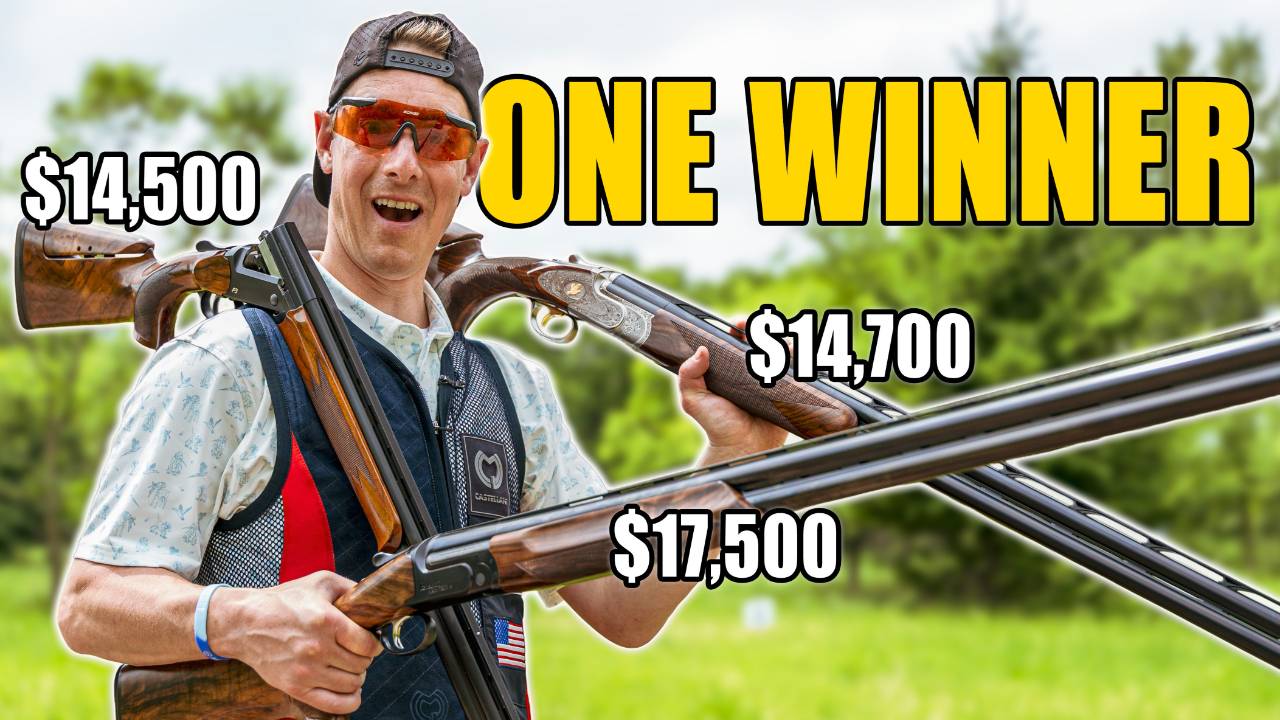
We have reviewed many shotguns, but when it came time to get an elite-level sporting shotgun, it was hard to decide which one to go with. So we did the only logical thing and got $50k worth of shotguns so we could shoot them side by side and decide.
Which one would you have kept? Let us know your thoughts on the TFL COMMUNITY!
Three Elite Sporting Clays Shotguns, One Winner
When we say elite, we mean the tier that starts around $12,000 and climbs from there. For our lineup we had the Parazzi High Tech S, Blaser F3 Advantage, and the Caesar Guerini Invictus V Ascent. And we already know what you are thinking: what about gun X, Y, or Z? Put it in the comments of the video, and we may make a part two where we pit the winner of this round against other elite shotguns.
How We Tested
Each gun got a full 100-bird round of sporting clays on the same course, on the same day, with the same shells. At each stand, we would rotate which shotgun we shot first, so no shotgun had an advantage on the course. That is 300 birds total, all of them with the Federal Master Class, 1 ounce at 1250 feet per second.
Alongside the shooting, every gun went through the SOSA test. That is 'Steve's Observational Shotgun Analysis to Effectively Save Time', the same scoring system used for the value ratings and overall scores on ShotgunFind.com.
SOSA grades on looks, ergonomics and handling, recoil and reliability, quality, vibes, and any bonus points. Every gun here took the same handicap for the price tier, so the scoring reflects the guns themselves and not the sticker.
The Lineup
Blaser F3 Vantage
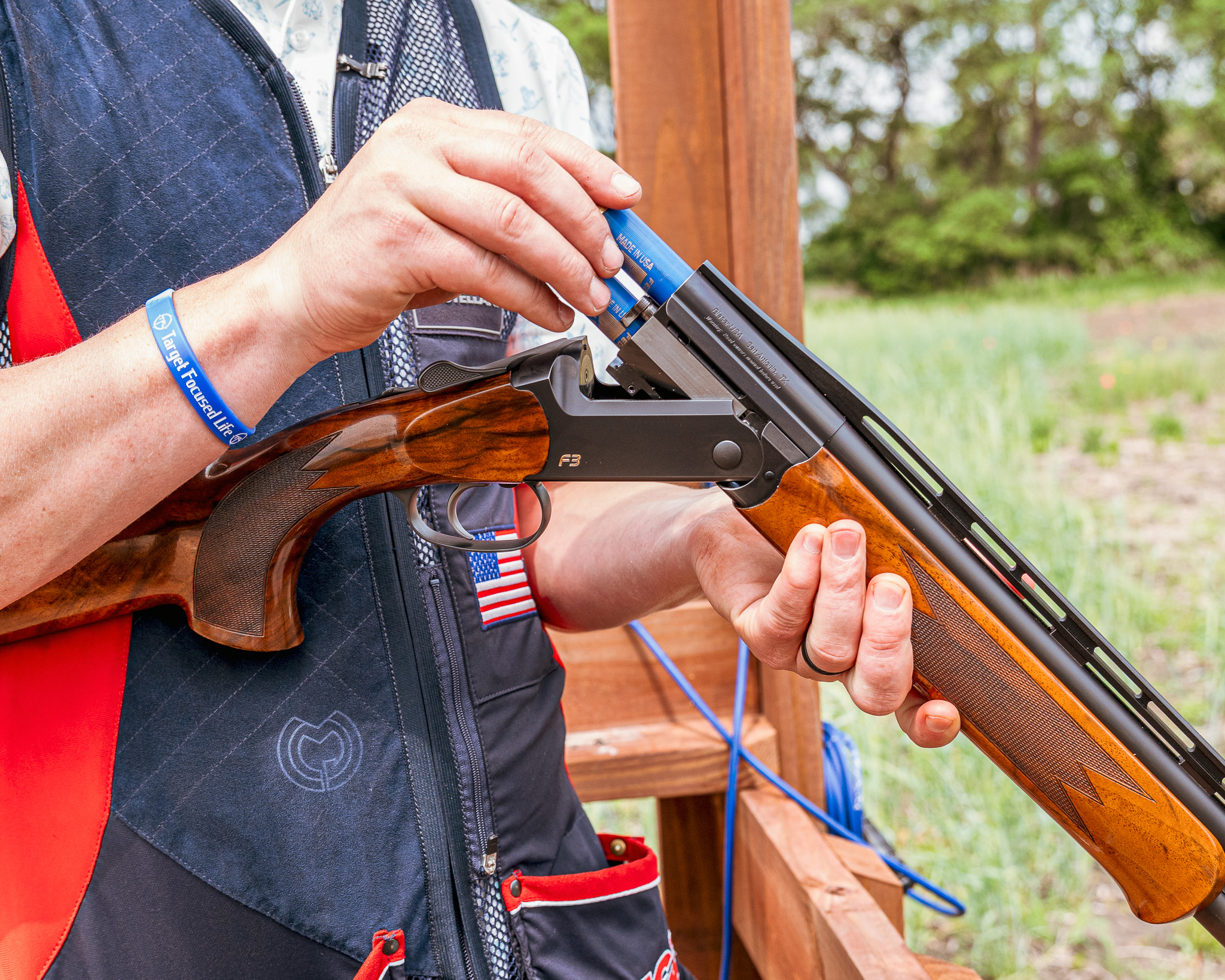 As tested: about $14,500, Vantage mid-rib, modular barrel and stock weight system. This one came from Nick McGlory at Woolley Shooting in Florida.
The Vantage rib is the reason this gun works for me. Long neck, long face, which lets me stay a little more upright and see the target clearly.
It is also the lightest gun in the lineup out of the box, but there is a weight system lets you do something about that. There is a threaded shaft with weights inside the stock and a bracket up front for barrel weights, so I added a little weight for overall feel and to balance the gun out.
Nick pointed to balance and pointability as the headline, and the slimmer profile is what makes it feel so lively in the hands. The striker-fired trigger is the other standout, with an extremely crisp break, minimal creep, and a very short reset.
Want the full breakdown? Read our complete Blaser F3 review.
Caesar Guerini Invictus V Ascent
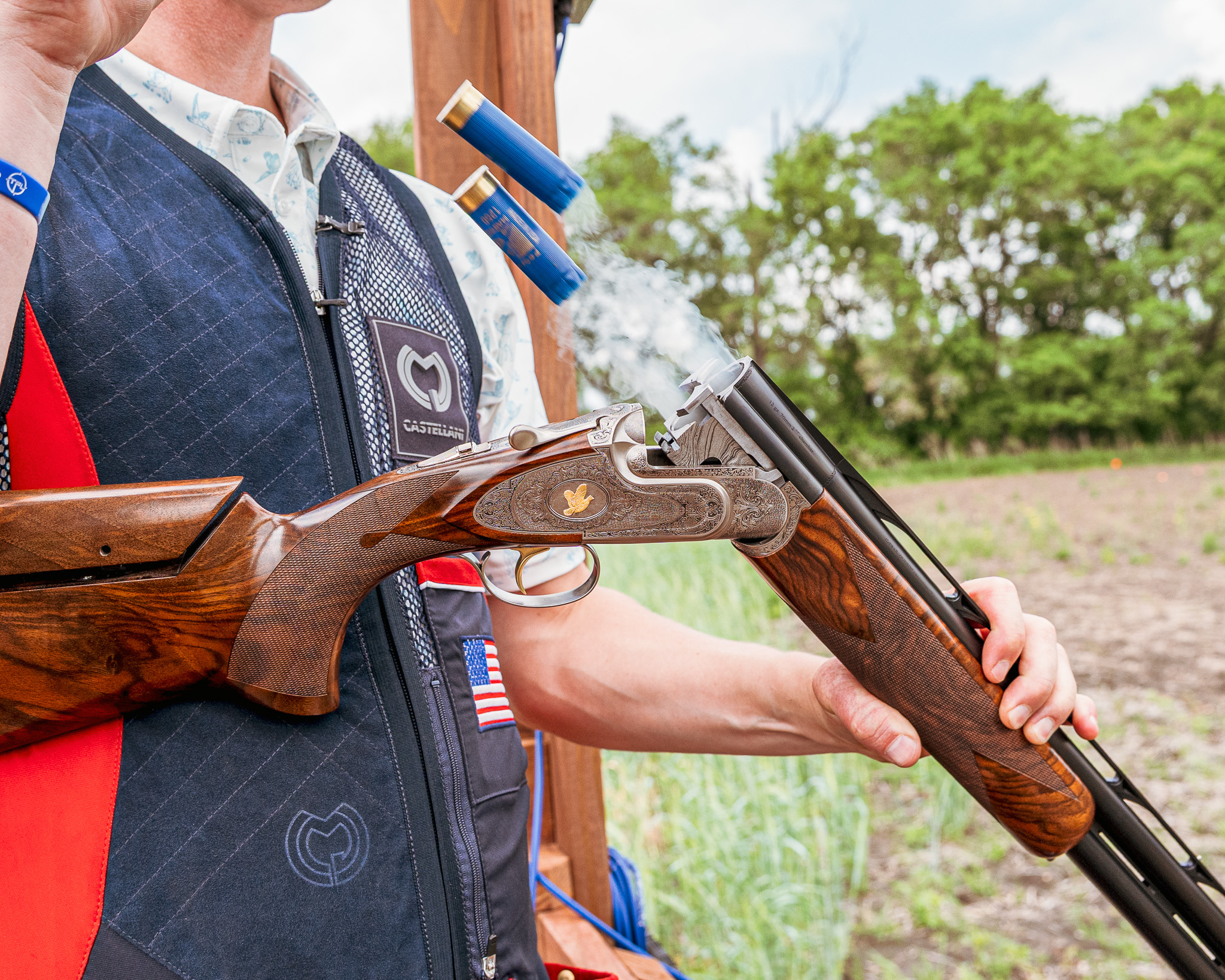
As tested: $14,700, Monte Carlo stock, stepped-up rib, full side plate. This one came from Drew Lieske at Orion Outdoors in Lake Orion, Michigan.
Quick note on the name, because it matters if you go shopping. The Invictus V is where side plates enter the lineup, and the Ascent is the step-up configuration on top of that, which is where the Monte Carlo stock and the raised rib come from. Although this setup was more than $14k, you can get into an Invictus I for around $10k.
We loved the looked of this shotgun. The full side plate gives the engravers a much bigger canvas, and the work on this one is machine-engraved and then hand-finished. The wood is genuinely beautiful, and if I am spending this kind of money, the gun had better be pretty.
It is also the gun I had the most reps with. I got it a few days before the other two and had already shot this course with it once.
Drew showed us an Invictus receiver to show what separates the line. Measure the thickness, and it is wider than most guns and noticeably wider than a Summit, which is Caesar Guerini's more entry-level series.
That extra material is what puts the weight and balance where you want it. Caesar Guerini says the Invictus components can handle a million rounds. That is the kind of number that turns a gun into something you hand down to a son or a grandchild.
Want the deep dive on the Invictus action? We covered the full lineup, Invictus I through IX, in our Caesar Guerini Invictus series review.
Perazzi High Tech S
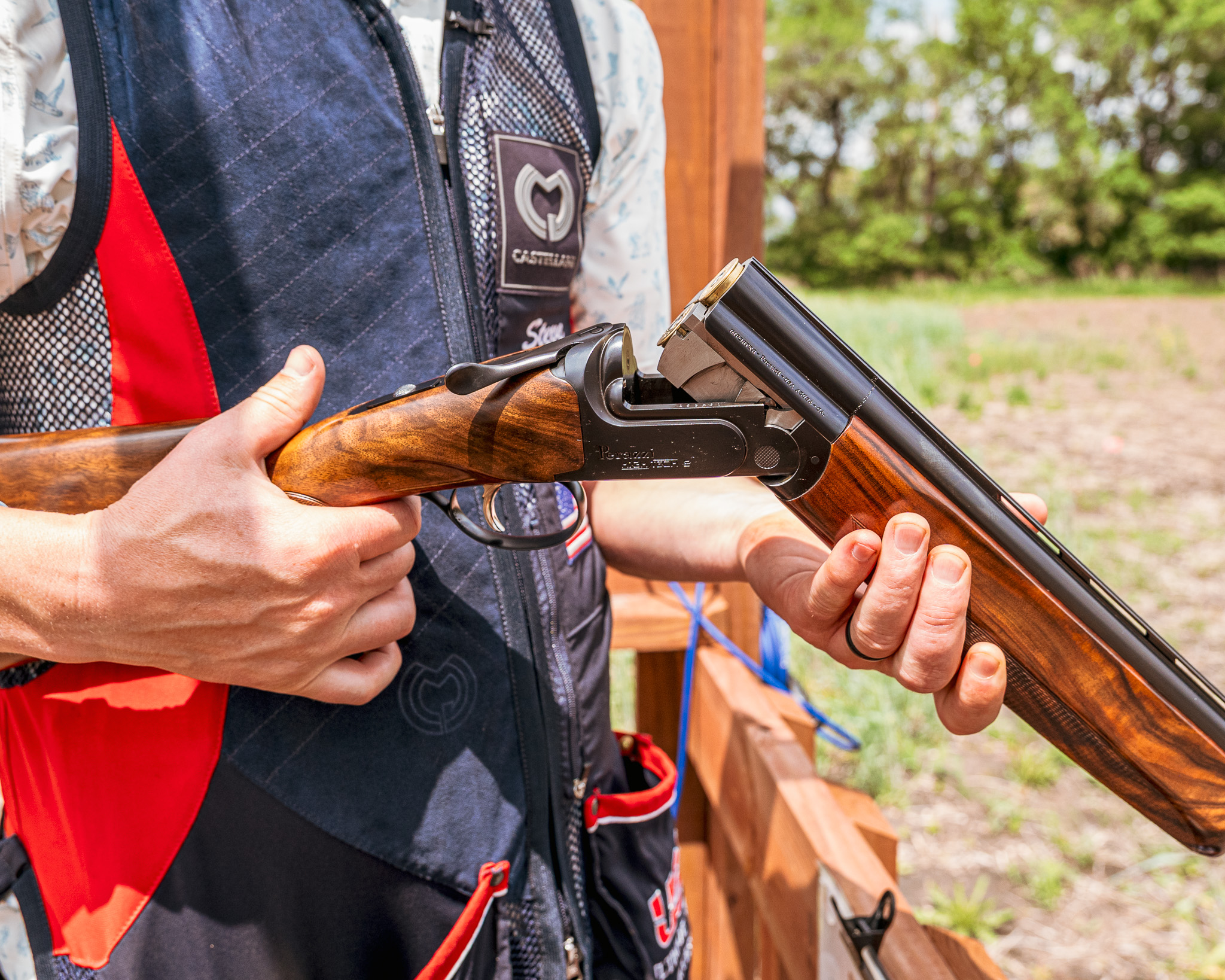
As tested: about $17,500, fixed stock with flat rib. This one came from Steven Berger at Berg's Outdoors in Louisiana.
On paper, this was the setup that fit me the worst. Fixed stock, flat rib, and I am used to a high-rib or a mid-rib gun.
It is worth saying that this configuration is not what you would have to live with. Order a Perazzi, and you get a custom stock built to your dimensions and your choice of rib, along with a long list of other options. If I were buying this one, I would go Monte Carlo with the rib stepped up.
Steven explained where the High Tech S sits in the lineup. If you know the Perazzi MX, this is the same idea, 3 mm wider, which works out to roughly an ounce and a half of extra weight sitting right between your hands.
That mass is what makes it easy to drive and easy to move. Steven called it a forgiving gun, and that turned out to be the whole story of the day. Make a good move and the gun shoots itself, and make a bad move and there is not so much mass in motion that you cannot stop it and correct.
Want the full breakdown? Read our complete Perazzi High Tech S review.
Ergonomics
Here is the honest headline from this test. Shooting three guns with different stock configurations and different rib configurations back-to-back is hard, and staying consistent across all of it was the real challenge of the day.
Invictus V Ascent: I felt like this gun fit me the best. The Monte Carlo stock is what I wanted, and I had it dialed in. I liked the way it sighted better than anything else out there. In the hands, it felt good.
F3 Vantage: sits second on fit. That long neck, long face rib keeps me upright and lets me see well, and the modular weights mean you can tune the balance wherever you want it. I liked the adjustable comb, but in the hands, the other two guns felt better.
High Tech S I thought this gun would have finished last on fit, and it did not. I was convinced a flat rib was not for me, but the point of aim was right where it needed to be. In the hands, this shotgun was money. The palm swell was spot on for me, and the gun was so smooth to move.
Recoil and Reliability
High Tech S: This gun handled recoil the best of the three. All that mass sitting between the hands does exactly what Steven said it would.
Invictus V Ascent: I got a little more felt recoil out of this one than the Perazzi. It still was not bad, and some of that could be fit rather than the gun. I had the stock dialed in, but it may need some more tweaking.
F3 Vantage: this one surprised me. It is the lightest gun in the lineup, which usually means you feel more of it, and it is actually fairly decent on recoil. I appreciate that.
As for reliability, we did not have a single issue across 300 birds. At this tier, that is what you should expect.
Want even less recoil? We love the FalconStrike recoil reduction systems.
Breakdown / Quality of Build
All three scored a perfect 10 on quality in the SOSA test, and that is not us being generous. At this price point, build quality is the entry fee, not the differentiator.
The Invictus makes the strongest durability argument. The wider receiver, the million-round durability, and the interchangeable parts in the receiver make this gun stand out.
The Blaser earns it through engineering. The striker-fired action, the trigger, and the modular weight system are all genuinely well executed.
The Perazzi earns it through the custom process. Everything from the stock to the rib to the wood is built to your order, and having watched them make these guns in person, the craftsmanship is real.
Shooting Experience
Three hundred birds later, the scores were not close.
- 84 with the Perazzi High Tech S
- 75 with the Caesar Guerini Invictus V Ascent
- 71 with the Blaser F3 Vantage
Nine birds is a significant gap, and it came from the gun I had never shot before. The High Tech S moved so smooth and so natural that targets I should have worked for just broke. When I hit them, I crushed them.
The Invictus is the result that surprised me most. This is the gun I had the most reps with and the one that fits me best, and it still came in nine birds behind. It moves really nice and it shined on several stations, but it did not add up on the card.
The Blaser was a victim of the format more than anything. I genuinely like it when I am shooting it on its own, but it is a lively gun, and bouncing between it and two heavier, slower-moving guns hurts. There was a bird or two per station that I think I lost purely to the weight and the speed of the gun.
SOSA Test Results
Every gun took the same handicap for the price tier, so this comes down to the guns themselves.
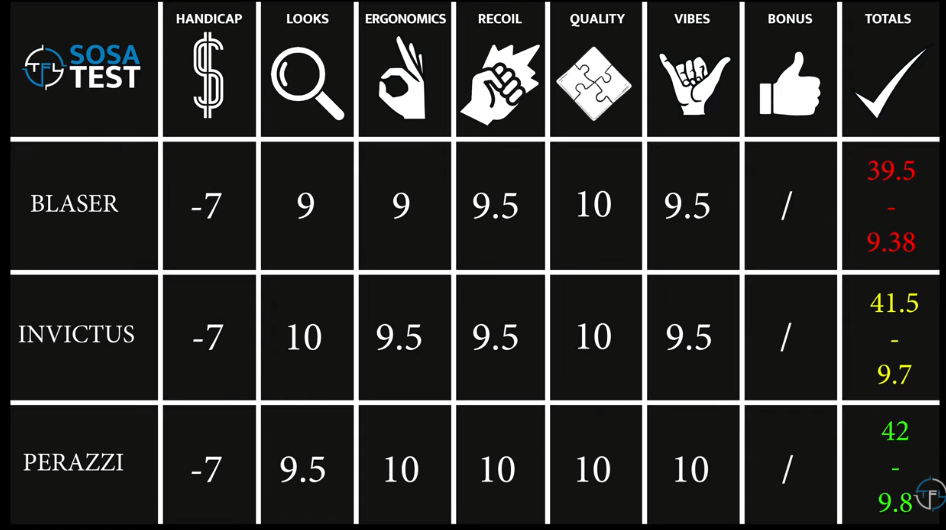
The Invictus took looks outright, and it deserved it. The Perazzi took ergonomics, recoil, and vibes.
A tenth of a point separates the top two. That is about as close as this test gets.
Final Thoughts
The Blaser F3 Vantage came out third, and I want to be fair to it. It is a lively, well-built gun with an excellent trigger and a rib I really like, and next to these two specific guns on this specific day, it got edged out.
Then it came down to the Perazzi and the Invictus, and I loved them both. Going in, I was sure the Invictus was my pick. It fits me better and I really like the Invictus system, and there is a lot about that gun I did not want to give up.
But I cannot argue with the card. The Perazzi won the 300 bird shoot by nine birds and won the SOSA test 9.8 to 9.7. When a gun takes both, there is not much left to debate.
So the Perazzi High Tech S is the one I am keeping, and it moves on to the next round.
Now we need your help with part two. What should the High Tech S go up against? A DT11, a Krieghoff K80, a Blaser FBX? Tell us, and we will go source the guns and drain the bank account this summer to get it done.
Which one would you have kept? Share your thoughts in the TFL COMMUNITY!
Whether our targets in the field or our targets in life, we'll only hit what we're focused on, live the #targetfocusedlife