I attended my first US Open this year and shot well below my current skill level. This was incredibly frustrating, so I visited with three-time National Champion and World Champion Zachary Kienbaum to pick his brain on how to shoot better when the pressure gets hotter.
In this article
Get Elite-level instruction from Zachary with his online course!
Sporting Clays Lessons from Zachary Kienbaum
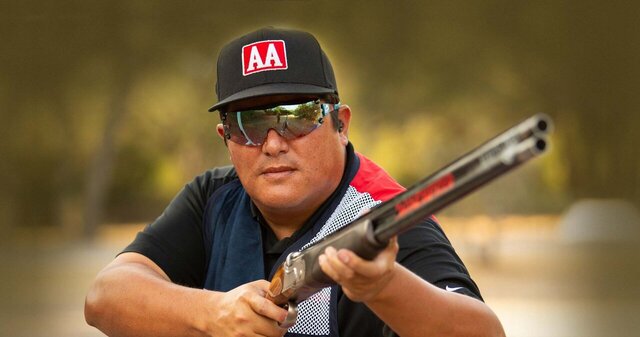
Zachary is a three-time NSCA National Champion, the 2024 FITASC World Champion, a 28-time All-American, and an inductee into the NSCA Hall of Fame in 2022. He won that world title on the very ground we were standing on at Game Unlimited in Hudson, Wisconsin.
And here I am, a self-taught trick shooter who makes content, asking him to help me figure out what I was doing wrong. He said yes without hesitating so we headed to the course.
What bothers me most about my score in my first round at the US Open is that I know what I am capable of. At the last event I shot, I put up a 92 out of 100. Then I show up at the US Open and shoot right around half of that. Zachary’s read on it was immediate, and it had nothing to do with my ability to break a target.
Thinking Versus Trusting
When you shoot with your buddies, nobody cares, and there is no pressure. Add a scorecard and the whole mindset changes. Zachary’s point is that training happens in a subconscious state. You see the bird correctly and your mind stays out of the way. Competition drags you into a conscious state where you start protecting the score instead of shooting the target.
After I reflected on that morning shoot, the phrase that kept coming back to me was thinking versus trusting. I was not trusting what I already know how to do. His answer to that is refreshingly simple. The only thing he wants you to do consciously is to tell yourself to keep your eye on the target. Everything else, the hold point, the move, the lead, you trust.
See It Break, See It Late
This is the line you will hear over and over in Zachary’s course, and it stuck with me. He wants your hardest, most intense focus on the bird at the exact moment you pull the trigger, and he wants you holding it until the bird breaks.
Here is what actually happens when the nerves show up. You want to know where the gun is, so your eyes come off the bird by just a fraction more than they would in practice. It is a tiny thing. It is also why watching a bird break in competition is so much harder than watching one break at home. Zachary put it this way, and I have not stopped thinking about it. You can lay your head down at night and admit you probably were not keeping your eye on the bird, even though in the moment you were certain you were.
Start Under the Line
On the first target I shot for him, I tried to stay on the line of the bird and I could not get it done. The second time I started lower and came up into it, and the bird broke.
Zachary is a big proponent of hold points sitting just slightly below the line, and he gave me two reasons why. The first is that you can always see the bird, because the muzzle never blocks it out. The second reason is the one I had not considered. Merging up to the line buys you timing, even though you are not moving directly with the line at first. His diagnosis of my very first miss was that my hold point was simply too far out. I never connected with the bird early enough to do anything with it.
Match the Speed and Forget the Lead
I was giving these birds far more respect than they needed. Zachary kept telling me I was out in front, and I kept being surprised by it. So he took lead off the table entirely. He told me to stop worrying about it, and to focus on one thing only, getting the gun and the target moving at the exact same speed through the end of the shot. The reasoning is that the closer your gun speed gets to the target speed, the more room for error you have as a shooter. If your gun is moving too fast or too slow, your perception of the gap changes every single time.
That is the part worth sitting with. He believes the varying speeds and angles on a course like the US Open are what wreck most shooters, not the leads. You already know the leads better than you think you do.
Your Eyes Are a Camera
Imagine your eyes are a camera, and you get to choose where they focus before you call for the bird. Zachary wants that focus set out at the distance where the target is going to appear or beyond it.
His example on our stand was perfect. We had a 32 inch barrel and a target coming out around 35 yards, and most people end up looking somewhere in between the two. He wants the leaves on the bushes behind the trap in focus when you call pull. Nothing closer. The reason is that your eyes work faster from out to in than they do from in to out. It is the same thing we teach kids in trap when we tell them to place their focus beyond the trap house not on it.
The Two-Second Rule on Long Birds
Long-developing targets have always been a challenge for me, because my instinct is to stare them down from the moment they launch. Zachary says the human eye only has a couple seconds of true hard focus on a moving object. God did not design our eyes to lock onto something moving for longer than that. So on a long, slow ride, staring at it the whole way is the kiss of death. You burn your focus before you ever get to the shot. He thinks about it in percentages. He moves with the bird at roughly 70 percent effort, then goes to 100 percent right as he breaks it, which means knowing exactly where you intend to kill the bird before you call for it.
The Collapsing Lead
This was the technique I had never played with, and it is the one I was most curious about going in.
A collapsing lead is for a crossing or quartering bird that has angle but not much time. Think of a target that is not fast, but is going to fall off the back side before you get a long look at it. On most shots, the bird comes out and you start moving. On this one, you do not move at all.
Zachary had me hold further away from the trap than I normally would, call pull, and simply let the bird squeeze in toward the gun. When it closes to the amount of space you are comfortable with, you start moving and you maintain that same gap through the shot. What it does is keep your gun speed from running away from you. When you pull off a slow crosser, it is very easy to get moving too fast, and the collapse lets the bird come into what he calls a quieter gun.
The first time I did it correctly, the whole shot seemed to slow down. That is exactly what it is designed to do. If you want the full breakdown of the collapse and every other approach to a target, that is what Zachary’s courses are built on.
This Is Not a Game of Perfect
Late in our session I broke the hard bird and then missed the easy one. Zachary reminded me that the winner of the US Open is not going to shoot 200 out of 200, and that this is a game of failure by design. You are allowed to drop birds.
The last piece of advice he gave me was about experience, and there is no shortcut for it. A good competitive shooter makes a mistake once and adjusts. A beginner needs to feel it two or three times. The only way across that gap is to enter more tournaments and learn what those emotions feel like.
Learn From the Best
Everything you just read came out of about twenty minutes on one stand. Zachary has close to four hours of it recorded, and that is the only reason I even knew to ask him about a collapsing lead in the first place.
That is actually the best example of why the course matters. He showed me the collapse on one target and it worked, but I still have no idea when to reach for it and when to leave it alone. The course walks through every approach to a target, why each one exists, and which presentation it belongs to.
The Foundation course is 29 chapters on the building blocks, the hold points, the vision, the setup. The Advanced course is another 29 that gets into specialty targets, competition pacing, equipment, and the mental side of shooting under pressure. Together, it is right around four hours.
Clay Target Instruction also has full courses from Anthony Matarese Jr., the first American to win the World English Sporting Championship, and George Digweed, who has 32 world titles to his name. You can buy a single instructor or grab access to all three.
Everything is streaming with lifetime access, it plays on any device, and there is a 30-day money-back guarantee. If you have been guessing your way through this game, this is where I would start.
🏆 Learn from the best, Sporting Clays:
My job now is to go apply it. I have reviewed plenty of the material, and none of it counts until I am standing in the box with a scorecard in my pocket.
Whether our targets in the field or our targets in life, we’ll only hit what we’re focused on, so live the #targetfocusedlife