
Way More Than a Factory | Inside Benelli's Italy HQ
Aug 20, 2026
Most of us picture a gun factory as dark, loud and covered in oil. Benelli's plant in Urbino, Italy is none of that. It looks more like a research lab. And once we understood the town it sits in, a place that gave the world Raphael and has been obsessed with getting things right for 500 years, the whole operation painted a whole new picture.
If you have experience with Benelli shotguns, let us know your thoughts on the TFL COMMUNITY!
Inside Benelli's Urbino, Italy Factory
Benelli invited us to Urbino to see how their shotguns are actually built. Not a highlight reel, not a press event. The full walk-through, from raw metal to finished gun.
What we expected was a factory tour. What we got was closer to a history lesson, and it changed how we think about a few things we had written off as marketing.
The Wall of Guns
Walk through the front doors and the first thing you see is a wall of shotguns running floor to ceiling. Some of them you would recognize immediately. Plenty of them were never meant to be sold. Prototypes. Experiments. Ideas they chased just to see if they would work.
That wall told us something before anyone said a word. This is a company that does not sit still.

The Town That Built the Company
To understand the guns, you have to understand the town. Urbino's roots go back to Roman times, more than 2,000 years. Its golden age came in the 1400s under a warrior turned ruler named Federico da Montefeltro, the Duke of Urbino.
He turned a small hill town into one of the great centers of Renaissance art and ideas. Today the entire historic center is a UNESCO World Heritage site. People there still call him the People's Duke.
This is also the town that produced Raphael, born in Urbino in 1483 and eventually one of the most famous painters in human history. Hold on to that, because the obsession that built this place never actually left. It just changed what it builds.

From Raw Billet to Finished Receiver
The first thing that hits you inside is the light. Bright, clean, open. It feels far more like a research lab than a gun plant.
It all starts with raw metal. We picked up an aluminum billet that will eventually become a receiver and watched the machining process that turns it into a recognizable shotgun part.
From there it heads to shot peening, then on to finishing. Anodizing for some, nickel plating for others, bluing for the steel barrels.
Shot peening was new to us too. Think of it a bit like sandblasting, and it leaves the surface uniform and consistent. It also works the metal itself, leaving the part stronger and giving an even base for whatever finish comes next.
Elsewhere on the floor we held a piece of forged steel that becomes the monoblock for the 828U. The whole job runs in a five axis CNC machine. Years ago, that same work happened on a lathe and took a tremendous amount of hand labor.
Machines That Run Themselves
Seeing a room full of CNC machines was no surprise. What surprised us was the sheer size of the factory and the number of them.
The bigger surprise was the machine learning. Billets feed in automatically, run through a series of milling stages, then come back around to a quality control station that checks every finished receiver against spec.
That same system monitors its own tooling and knows when a tool needs replacing. It runs almost entirely on its own. That was a real look at where precision machining is headed.
Advanced Impact Barrels
Benelli's newer barrel technology is called A.I., which is short for Advanced Impact. We will be honest, we walked in a little skeptical of the claims, so we asked directly.
The short version is that they ran an extensive testing program looking at every variable inside the bore profile, then settled on the profile that produced the best external ballistics.
It comes down to balancing bore diameter against pressure inside the barrel, friction between the barrel and the shot, and the deformation the pellets take on the way out. Rounder pellets fly better. Better pellets at the muzzle mean more speed and more retained energy downrange.
We did not know it during the tour, but Benelli would go on to challenge us to use those A.I. barrels to chase the world record for the longest shot on a flying clay. We already held a record at 180 yards, so no small ask. What we pulled off blew even our minds. Go see it for yourself.
BE.S.T. Coating
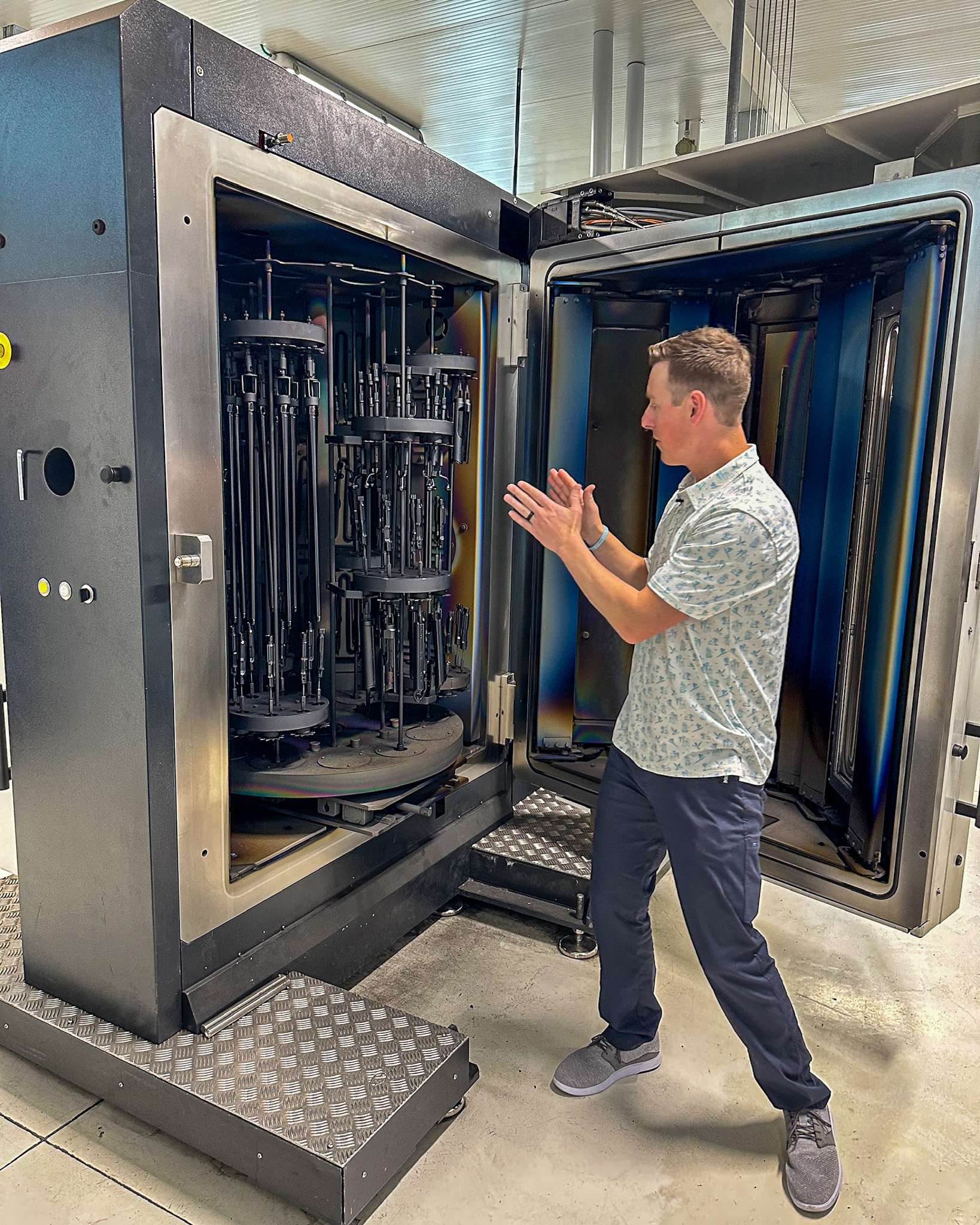
This was the best part of the factory, and we mean that literally. BE.S.T. stands for Benelli Surface Treatment, and it took them more than a decade to develop.
A polished steel barrel goes into the machine and comes out transformed. The process runs for eight hours, involves significant heat ionization, and occurs in a vacuum. The result is incredibly durable, corrosion-resistant, and scratch-resistant.
It is loosely similar to a diamond-like coating, but it was achieved in a completely different way, and the process is proprietary to Benelli.
Here is the breakthrough. A process like this normally runs hot enough to ruin a barrel's ballistics. Benelli figured out how to do it cold, so you get armor without sacrificing performance.
Their salt fog testing tells the story. A standard blued barrel was completely rusted in 4 hours. A BE.S.T. barrel went 200 hours without a hint of rust. They are confident that they back it with a 25-year corrosion- and scratch-resistant warranty.
You can duck hunt in saltwater, not get the gun cleaned right away, and it is not going to corrode on you.
Cryogenic Treatment
Around one corner of the factory sits a set of very serious freezers where Benelli barrels go for a deep chill at 300 degrees below zero.
We have heard Benelli talk about cryogenic treatment for years without ever fully understanding it, so we sat down with a metallurgist who explained it at a molecular level. Here is the version we can repeat.
Manufacturing and heat treating leave behind small imperfections in the metal. Freezing the barrel realigns the molecules and evens things out.
Without that step, a barrel can shift slightly over time as you shoot it, and you lose consistency. Cryogenic treatment is one more step toward the same result every time, in shotguns and rifles alike.
Quality Control and an AI Wood Grader
Quality assurance runs with a team of twelve people checking machined parts for spec and sizing. That part we expected. The rest of the room, we did not.
There is an AI wood grading tool that photographs a stock blank and grades it against the standards and parameters Benelli has trained it on. It takes a judgment call that used to vary from person to person and makes it consistent.
Next to it, another machine scans a forend at a million different points, confirming size, shape and spec down to a level the human eye cannot touch.
Then there is the metallographic lab, which is honestly out of our league. They examine steel and metals at a molecular level to verify everything from heat treatment to coatings. They are also running research in there for whatever comes next.
What the Names Really Mean
Here is the thing we kept noticing. A Benelli does not just work; it looks like something. The lines, the wood, the way it feels in your hands.
In Raphael's hometown, that is no accident. The model names give it away because they are basically tributes to the town.
The Montefeltro is named for the Duke himself. On the 828U, 828 is Urbino's UNESCO World Heritage number and the U stands for Urbino. The Super Black Eagle takes its eagle from Federico da Montefeltro's coat of arms, the same eagle the warrior duke carried on his shield.
These guns carry their roots everywhere they go.

Final Thoughts
We went to Italy expecting a factory tour. We came home with a history lesson.
What stuck with us was the pattern. Obsession stacked on obsession, and almost all of it invisible. You will never see the shot peening, the cryogenic treatment or the hours in the coating chamber.
A Benelli is not really a standalone product. It is the latest chapter of something this little town started 500 years ago. The same refusal to settle, the same drive to get it right and then make it better, the same belief that a thing can be useful and beautiful at the same time.
One could say the Renaissance never really left Urbino. It is just that now they build shotguns.
What do you think about Benelli? Share your thoughts in the TFL COMMUNITY!
Whether our targets in the field or our targets in life, we'll only hit what we're focused on - live the #targetfocusedlife